
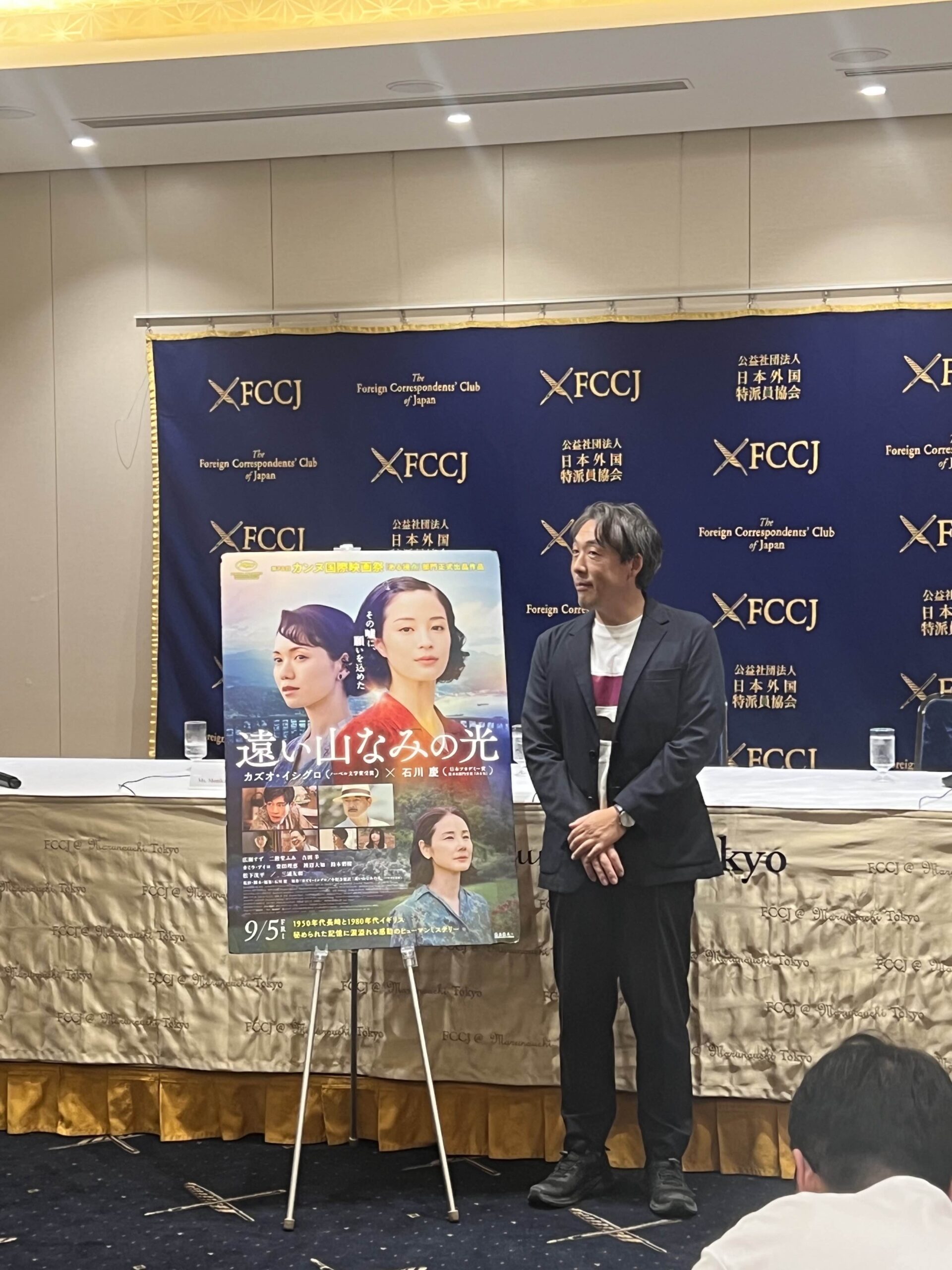
On Wednesday, the Foreign Correspondents’ Club of Japan hosted a preview screening of A Pale View of Hills, followed by a press Q&A with film director Kei Ishikawa. The film is based on a Nobel Prize–winning novel that unfolds across two parallel timelines: Nagasaki in the 1950s, in the aftermath of World War II and the atomic bombing, and the U.K. in the 1980s. At the heart of the story are three women — Etsuko, her daughter Niki, and a woman from Etsuko’s past Sachiko — whose intertwined perspectives explore trauma, identity, and freedom.
The film, which drew international attention with its official selection in the Un Certain Regard section of the 78th Cannes Film Festival, has now been confirmed for the Special Presentations program at the 50th Toronto International Film Festival, opening on September 4. The film will be released to the general public in Japan on September 5.
As the screening concluded, Ishikawa took questions from foreign journalists, speaking in detail about everything from his historical research and preparations to the actual production process. He emphasized the importance of the film as a reminder to the world not to forget the tragedy, especially as this month marks 80 years since the bombings of Hiroshima and Nagasaki.
The film tackles difficult themes that still echo in today’s world, and Ishikawa unpacked them throughout the Q&A session.
Historical Relevance
When asked why he chose to adapt Ishiguro’s novel, Ishikawa admitted that he had long struggled with the weight of its themes. “I had always thought that one day I would like to adapt a Kazuo Ishiguro work into a film. But when it came to themes like the atomic bomb and war, I felt they weren’t really my generation’s topics — they were subjects that should be handled by the older generations, by those who had actually lived through them,” Ishikawa said.
He confessed he once avoided tackling the subject, thinking it was not his place. “I used to think that even if we tried to imitate, we could never get close. I kept running away, telling myself it wasn’t our story to tell. But if we continue like that, memories will soon turn into records, and before long, into history. That’s why we need to take it on ourselves, as a story of small, personal memories,” he said.
For Ishikawa, Ishiguro’s distance from Japan paradoxically became a source of strength. “What really gave me courage was the fact that Kazuo wrote this story in English, from the U.K., while holding Nagasaki in his heart. That sense of distance, I realized, actually feels very close to how our generation relates to topics like Nagasaki, the atomic bomb, and the postwar era. And it’s precisely because of that distance that we don’t have to trace the past as it was — we can tell it in our own way,” he said.
Global Resonance
In discussing how the film could reach both Japanese and international audiences, Ishikawa emphasized that its themes transcend a single place or period, touching on issues with universal relevance.“This film places the atomic bomb and Nagasaki at its core, but it’s not only about anti-nuclear themes. It also touches on issues such as gender and immigration,” he said.
“To me, it’s a film about the new values that our grandparents’ generation fought so hard to win in postwar Japan. And when you think about it that way, it’s not just a Japanese issue. What’s more, those values our parents’ generation secured after the war are now in jeopardy. That’s why I believe this story will truly resonate with people around the world, and why I felt the need to bring it to them through this film.”
Inheritance
Ishikawa explained that the relationship between Etsuko and Niki in the 1980s captures how memories are transmitted: it is not about fully understanding every detail, but about accepting the blurred, imperfect fragments that are handed down. “This is a story of Etsuko’s memories. As Niki listens to her, I didn’t think it was necessary for her to understand everything,” he said.
He said that memory often remains blurred, with parts that may not be entirely factual, which is a reality we all live with. “Even if you can’t claim to fully understand, taking it all in as Niki does, it is itself a way of inheriting history,” he said. “That’s how things are passed down, I realized. It may appear to be a small story between a mother and daughter, but to me, it felt like an immense theme.”
Comments are closed.